
The Cyclades are one of the most iconic cruising grounds in the world. With whitewashed villages, turquoise waters, and islands galore. But there’s one natural force every charter guest and planner should understand before setting sail: the Meltemi winds. These strong, seasonal winds can turn a smooth sail into a dangerous day at sea.
What Are Meltemi Winds? (And Why Do They Matter?)
The Meltemi winds are a persistent northerly wind pattern that blows across the Aegean Sea, especially the Cyclades, from late May through September. They are driven by the pressure difference between high pressure over the Balkans and low pressure over Turkey.
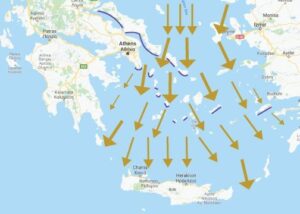
Typical Characteristics
- 🌬️ Direction: Strong northerly winds
- 💨 Speed: Often 20–30+ knots, with gusts sometimes exceeding 35 knots
- 🕐 Duration: Can blow consistently for several days at a time
- 📍 Timing: Strongest in July and August, milder in May–June and September
Unlike random weather systems, the Meltemi is a predictable seasonal wind, in the Cyclades and it’s one of the most important elements to plan around.
How the Meltemi Affects Charter Routes
1. Comfort and Sea Conditions
Strong Meltemi winds create:
- Larger seas and more chop
- Increased swell in open water
- More challenging anchoring conditions
This means that for some guests, particularly those prone to seasickness or preferring calmer water, certain routes become less comfortable during peak Meltemi. It also means guests can get stuck at a marina or protected cove for days at a time.
2. Route Planning & Island Selection
Best Cyclades Routes During Meltemi
Because the wind comes from the north, experienced charter skippers often plan:
✅ South-facing anchorages and coves for protection
✅ Routes that allow you to sail with the wind rather than against it
✅ Islands with lee sides (Mykonos, Syros, Naxos, Paros)
Routes That Can Be Rougher
❌ Direct east-west crossings across open Aegean
❌ Completely exposed anchorages
❌ Long open water passages in the middle of the wind fetch
One common strategy is to sail from Naxos to Paros to Sifnos, which keeps the wind on a more comfortable beam or stern angle, rather than heading directly from Mykonos to Santorini into a headwind.
3. Leadership, Safety, and Experience
The Meltemi is not a reason to cancel a charter or avoid the Cyclades but it is a reason to:
🔹 Work with a broker who understands seasonal conditions
🔹 Build a flexible itinerary and understand that it might change with the weather
Timing Your Charter for the Best Experience
Here’s a breakdown of what to expect by month:
🌼 May – Early June
✨ Meltemi winds are milder
☀ Ideal time for first-time Cyclades charters
🚤 Easier sailing conditions
☀️ Late June – August
💨 Stronger, consistent Meltemi
📆 Best sailing winds for performance sailors
⛵ More challenging seas for beginners
🍂 September
🎯 Winds begin to moderate
🌅 Excellent mix of stable weather and calmer seas
🌍 Great option for comfort-focused charters
Tips for Guests & Charter Planners
✔️ Before You Book
- Know that your itinerary can change based on weather patterns.
✔️ During Your Charter
- Work with your captain to adjust daily plans
- Favor sheltered anchorages when winds pick up
- Embrace the wind on comfortable sailing days!
Why the Meltemi Is Not As Bad As You Think
Though it can be intimidating, the Meltemi:
✅ Provides reliable, predictable wind
✅ Makes for fantastic sailing when harnessed correctly
Final Takeaway
Understanding the Meltemi winds is essential when planning a Cyclades charter.
With the right season, experienced planning, and flexible routing, the Meltemi can elevate your sailing experience, not derail it.